Bangladesh politics today: key facts and future outlook
On January 7, 2024, polling stations across Bangladesh opened under a sky of routine expectation.
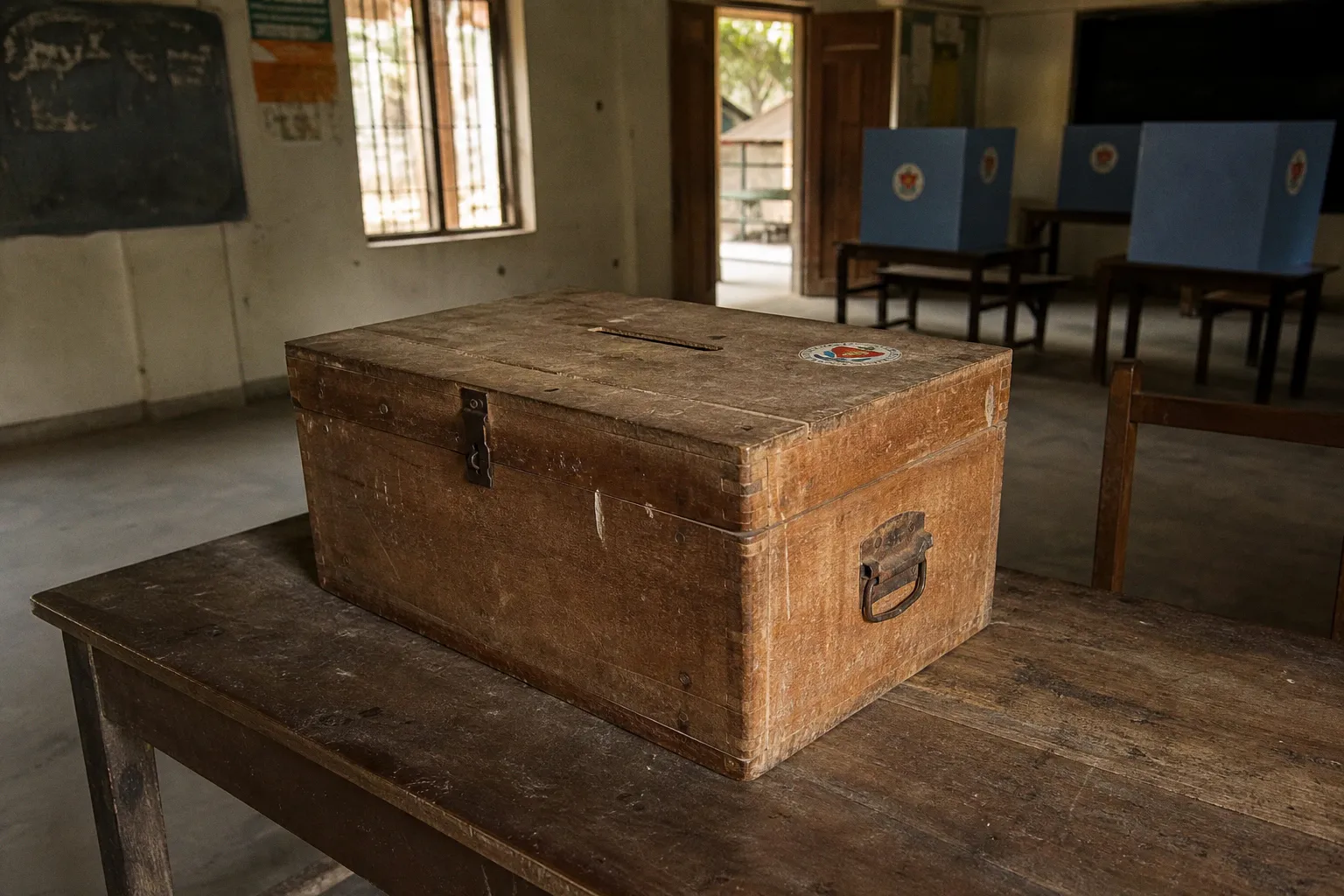
Bangladesh After the Fourth Term: A Parliament, a Boycott, and the Long Road to 2029
For readers tracking Bangladesh from outside, the question is less about the headline result and more about the architecture of governance now in place: how a parliament functions without meaningful opposition representation, how the courts handle politically sensitive cases, how a small South Asian economy balances between Beijing, Delhi, and Washington, and how a country hosting more than a million Rohingya refugees negotiates its humanitarian obligations with its regional posture. This article walks through each of those fault lines, drawing on the institutional record and the on-the-ground signals visible from Dhaka.
The 2024 Electoral Landscape and Parliamentary Shift
The arithmetic of the 12th Parliament tells its own story. Of 299 seats up for contestation, the Awami League's 223 represented a working majority, with the remaining allocations distributed largely among smaller parties and independents whose relationship with the government ranges from cooperative to transactional. Jatiya Party candidates retained a foothold through arrangements with the ruling bloc, a configuration that produces legislative predictability but compresses the volume of floor dissent.
The boycott reshaped the meaning of those numbers. Turnout figures reported by the Election Commission placed voter participation below forty per cent nationally, the lowest since the restoration of parliamentary democracy in 1991. International observation missions were either absent or limited in scope, and the diplomatic readouts that followed ranged from the notably muted to the explicitly cautious. New Delhi, Beijing, and a select group of South Asian and Middle Eastern partners offered congratulations; Western chancassies largely refrained.
A parliament without competitive contestation is not the same institution as a parliament that has lost one.
What the post-election landscape does have is administrative density. The cabinet was reconstituted within weeks, ministries continued to function, and the bureaucratic rhythm of policy issuance did not pause. For an executive accustomed to governing from a position of parliamentary strength, the absence of opposition benches removes one set of friction while introducing another: the difficulty of claiming a popular mandate when major segments of the political class refuse to compete for it.
Opposition Boycotts and the Crisis of Political Legitimacy
The BNP's decision to withdraw did not emerge in a vacuum. The demand for a caretaker administration — a constitutional feature Bangladesh experimented with between 1991 and 2011 before its abolition — has been a recurring fault line. The ruling party has argued that the mechanism invited constitutional mischief; the opposition has insisted that without an independent transitional authority, elections conducted under an incumbent government cannot be considered free. Both positions rest on accumulated experience, and neither side has shown inclination to revisit the underlying compromise.
The practical consequences are visible in three registers. First, the parliamentary opposition, as a counterweight within the chamber, has thinned to a rump. Second, political activity has migrated to the street, to social media, and to the courts — venues where the BNP and its allies have sought to reframe a contest they declined to fight at the ballot box. Third, foreign governments and multilateral institutions, which had once treated election cycles as inflection points in the bilateral relationship, now calibrate their engagement to longer horizons of institutional performance rather than to a single day in January.
This shift is not unique to Bangladesh, but the country's two-party inheritance makes the legitimacy question especially sharp. Bangladesh's political rhythm has long alternated between Awami League rule and BNP-led coalitions, with the military intervening twice when that alternation broke down. A government presiding over a diminished opposition is a familiar figure in Bangladeshi history; what is less familiar is the speed with which the question of who counts as a legitimate participant is now being settled outside the polling station.
Judicial Independence and Civil Liberties Under Scrutiny
No analysis of Bangladesh's political weather can ignore the courts. The judiciary sits at the intersection of a dense political caseload — opposition leaders facing trial, business figures under investigation, journalists and civil society actors whose licensing and freedom of movement are administered by state functionaries. International rights monitors have flagged the handling of cases involving senior opposition figures as a recurring concern, noting patterns of prolonged pre-trial detention, restrictions on defence access, and sentencing that appeared, in several high-profile instances, to follow political calendars.
| Domain | Documented concern | Domestic counter-argument |
|---|---|---|
| Pre-trial detention | Lengthy remand periods without charge in cases involving opposition politicians | Procedural compliance with the Code of Criminal Procedure |
| Press freedom | Use of the Digital Security Act and successor legislation against journalists and editors | National security and protection of state institutions from defamation |
| Civil society | Foreign funding restrictions under the NGO Affairs Bureau | Sovereign right to regulate cross-border resource flows |
| Trial conduct | Reports of judicial pressure and limited defence cross-examination | Independence of the subordinate judiciary is constitutionally protected |
The table compresses a more complex reality; few of these questions admit a single-line answer. What is consistent, however, is the trajectory: an expanding body of legislation that grants the executive wide discretion over who can speak, who can assemble, and who can be questioned — and a judiciary whose capacity to push back, in politically consequential cases, has narrowed in the eyes of external observers. Domestically, the argument runs that the legal architecture is necessary for stability and that the measures are applied with equal hand. Internationally, that argument has lost purchase.
For an investor weighing Dhaka against Hanoi or Jakarta, the question is not whether the law is on the books but whether it is applied predictably. On that metric, the post-2024 environment has produced fewer surprises than detractors feared and fewer reforms than reformers hoped for. The constitutional court's standing, the appellate bench's workload, and the lower judiciary's exposure to administrative influence are the institutional details that will determine whether the next five years see an incremental expansion of legal space or its steady contraction.
Navigating the Indo-Pacific Outlook and Foreign Relations
Bangladesh's foreign policy operates on a doctrine of equidistance that is genuinely held rather than merely rhetorical. The Indo-Pacific Outlook, formally adopted in April 2023, articulates a vision of a "free, open, peaceful, secure, and inclusive" region while explicitly declining to join the security-oriented coalitions that have proliferated since 2017. The language is calibrated: support for freedom of navigation, commitment to peaceful dispute resolution, an affirmation of multilateral trade, and a studied silence on the questions that would force Dhaka to choose.
That silence has begun to acquire texture. Bangladesh's economic gravitational centre remains India, which absorbs the largest share of the country's exports and supplies a structural share of its energy imports. China remains the largest source of infrastructure financing, particularly in the power and transport sectors. The United States and the European Union, having imposed sanctions frameworks on individuals associated with electoral manipulation and security-force conduct, have narrowed the diplomatic aperture without closing trade ties. Japan continues to operate as a development partner of the first rank, particularly in the Matarbari deep-sea port and the Dhaka metro.
The result is a country whose diplomatic calendar is unusually full. Visits from each of these partners follow a choreographed rhythm; press releases are calibrated to signal continuity with one audience without alienating another. For Bangladesh's interlocutors, the question is whether this equidistance can hold as regional pressure intensifies — when the Quad's agenda demands a position on the South China Sea, when the BRI's second phase places new choices before Dhaka, when the U.S. sanctions regime names more individuals. So far, Dhaka's answer has been to insist that the region's security architecture is not a binary choice. That posture is intellectually coherent and politically sustainable, though observers note that the room in which to maintain it is narrower than it was five years ago.
Humanitarian Pressures: The Rohingya Refugee Standoff
The camps in Cox's Bazar hold more than a million Rohingya, the great majority of them driven across the border in the waves of violence that began in August 2017. Nearly eight years on, the camps are not a temporary arrangement; they are an entrenched humanitarian geography, with schools, clinics, and a shadow economy that has reshaped the political economy of the host district. Bangladesh did not choose to become the world's largest host of stateless people, and it has consistently framed its position as one of patience reaching its limits.
Repatriation, the formal exit strategy, has been at a near-standstill. The structural obstacles are well known: the security situation in northern Rakhine State, where the Arakan Army's offensive has displaced additional Rohingya into Bangladesh since late 2023; the absence of a credible civic documentation regime in Myanmar; the Rohingya's refusal to return without guarantees of citizenship and freedom of movement. Each round of tripartite talks between Dhaka, Naypyidaw, and the UNHCR has produced communiqués rather than convoys.
The pressure now runs in two directions. Donor fatigue is real; humanitarian appeals in 2024 were underfunded relative to assessed need, and aid agencies have begun to scale back services in a manner that residents describe with increasing alarm. Simultaneously, domestic political sentiment — already complex in a district that has absorbed significant demographic change — is hardening. Local politicians, on both sides of the national divide, have tied their platforms to the demand that the Rohingya presence cannot be indefinite. The government has floated relocation to Bhasan Char as a partial answer; international monitors have questioned the voluntariness of relocations and the sustainability of life on the island.
A refugee camp that becomes a city is no longer a humanitarian file; it is a question of statecraft.
This question will outlast the current parliament and, almost certainly, the next. What is being institutionalised in Cox's Bazar is a de facto second border, one that Bangladesh did not draw but must administer, and one whose eventual resolution depends on political decisions in Naypyidaw that are not within Dhaka's gift.
Reading the Signals: What to Watch Between Now and 2029
Five years is long enough for an opposition to reorganise, for an economy to shift, for a court to expand or contract its docket, and for a foreign-policy posture to be tested. Five years is also short enough that the inertias already in motion will dominate. The signals worth tracking are not the headline exchanges between Dhaka and Washington but the quieter ones: how the courts handle the next set of opposition trials, how the bureaucratic regulation of NGOs and media outlets evolves in practice, whether the equidistance posture survives its first genuine pressure test, and how the Rohingya file is reframed as either a humanitarian transition or a permanent feature of the regional landscape.
For external readers — investors, diplomats, correspondents, and the Bangladeshi diaspora — the country's political story in this term is unlikely to be the electoral one. That script has already been written. The story that has not, and that will define Bangladesh's trajectory through the late 2020s, is whether the institutions of governance can hold their shape under the pressures they currently absorb.