Fund a Bangladesh startup: venture capital vs angel networks
Bangladesh’s startup financing market has moved beyond informal patronage, but it has not yet become a deep venture market.
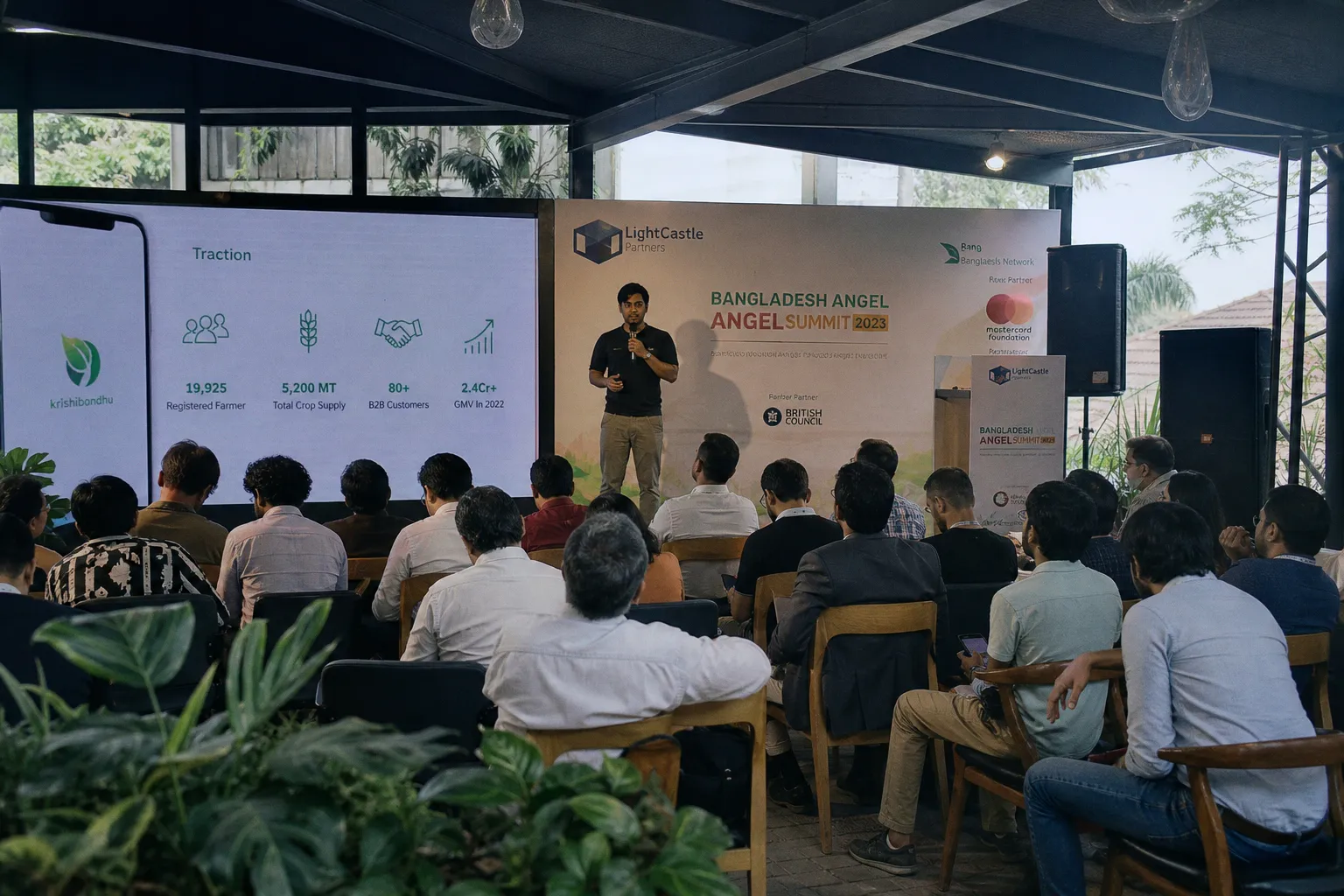
The practical financing corridor for an early Bangladesh startup still begins with small government grants, founder capital, and angel cheques, while institutional venture capital usually enters only after traction, revenue visibility, or a defensible distribution advantage can be demonstrated.
The distinction matters because the wrong capital source can distort a company before the market has validated it. An angel network writing a $25,000–$250,000 seed cheque is not solving the same problem as a venture fund assessing scale economics in fintech, logistics, or e-commerce. Nor does a BDT 10 lakh government grant under the iDEA project perform the same function as equity capital. These instruments sit at different points in the risk curve, and the founder who treats them as interchangeable is usually mispricing both dilution and execution risk.
The evolving landscape of early-stage capital in Bangladesh
The Bangladesh startup ecosystem has developed within three overlapping structures: a large domestic consumer base, rapid adoption of mobile financial services and internet-enabled commerce, and a capital market that is still relatively shallow for high-risk private technology companies. This combination produces a familiar contradiction. Market demand can be real, especially in Dhaka and other urban centres, but the financing architecture remains selective, relationship-driven, and unevenly transparent.
The formalisation of venture and private equity investment received an institutional basis when the Bangladesh Securities and Exchange Commission introduced the Alternative Investment Fund Rules in 2015. The rules created a statutory framework for venture capital and private equity funds, which was necessary for a market that had previously relied heavily on informal arrangements, offshore structures, and bilateral investor-founder negotiations. A legal framework does not by itself create liquidity, but it reduces ambiguity for fund managers, sponsors, and institutional allocators.
Since then, the investment map has become more structured. Local angel groups, including Bangladesh Angels Network, have operated at the pre-seed and seed end of the market. Local venture investors such as Anchorless Bangladesh have built a more institutional thesis around Bangladesh’s digital transformation. Regional funds from Singapore, India, and the Middle East have monitored the market because Bangladesh offers population scale, rising internet penetration, and underpenetrated digital services. The capital is present, but not indiscriminate.
For a founder, the central question is therefore not whether Bangladesh has startup funding. It does. The question is which category of capital matches the company’s present stage, evidence base, and capital requirement.
A Bangladesh startup seeking capital normally moves through a sequence:
1. Founder and informal capital to test whether the problem is real and whether a minimum product can be built without external governance obligations.
2. Government grants or ecosystem support, where applicable, to finance early experimentation without immediate equity dilution.
3. Angel capital to convert a working concept into initial customer acquisition, hiring, and market validation.
4. Institutional venture capital to finance rapid scaling once unit economics, retention, and distribution channels become measurable.
5. Later-stage or strategic capital for category consolidation, regional expansion, or regulated-sector execution.
That sequence is not mandatory, but it reflects the risk appetite of each investor class. Founders often prefer to start the conversation at venture capital because it carries status and larger numbers. Investors usually begin elsewhere: with evidence.
Capital in Bangladesh is not scarce in the abstract; it is scarce for companies that cannot define the stage of risk they are asking investors to underwrite.
Angel networks: the first institutional filter
Angel networks occupy the financing layer between personal backing and venture capital. In Bangladesh, their role is particularly significant because many technology companies begin with limited assets, incomplete revenue data, and a market hypothesis that still requires field testing. A bank will not finance that profile without collateral. A venture fund may regard it as too early. An angel investor can price it as seed-stage risk.
Bangladesh Angels Network and similar groups typically focus on pre-seed and seed rounds, with investment ranges commonly cited between $25,000 and $250,000 in exchange for equity. At that size, the cheque is large enough to extend runway, hire core staff, launch pilots, and generate early commercial data. It is not large enough to carry a company through multiple years of subsidy-led expansion, and founders should not treat it as such.
Angel capital is most useful when the company has moved beyond an idea but has not yet accumulated enough operating metrics for institutional venture capital. The relevant evidence may include:
- early paying customers, even if revenue remains modest;
- repeat usage or retention signals in a digital product;
- a founder-market fit that is credible in a regulated or operationally complex sector;
- pilot results with merchants, logistics providers, schools, clinics, or SMEs;
- initial data on customer acquisition cost, although still unstable;
- a clear reason why capital will change the company’s trajectory rather than merely pay salaries.
The strongest angel rounds in Bangladesh tend to combine capital with local operating intelligence. This is especially relevant in sectors where distribution is fragmented and execution depends on merchant behaviour, cash collection cycles, field sales, or regulatory awareness. A fintech startup, for example, may require knowledge of payment rails, compliance expectations, and mobile financial services partnerships. An e-commerce enablement company may need access to SME networks and logistics infrastructure. A healthtech or edtech venture may face slower adoption and more complex trust-building.
Angel networks can also impose useful discipline. A founder raising from individual acquaintances may face unclear terms, inconsistent expectations, and weak governance. A structured angel network normally introduces a more formal process: pitch review, diligence, valuation negotiation, shareholder agreements, and post-investment reporting. That process can be demanding, but it often prepares the company for later venture discussions.
The limitation is also clear. Angel investors cannot usually finance aggressive scale alone. If the business model requires substantial working capital, nationwide infrastructure, large engineering teams, or regulatory capital buffers, the angel round is a bridge, not the destination. It should be designed to create the proof required for the next stage.
Venture capital: scale capital, not validation capital
Venture capital in Bangladesh is frequently misunderstood as a larger version of angel investing. It is not. A venture fund is structurally designed to seek outsized returns from a portfolio in which many investments may fail or underperform. That model requires companies that can plausibly expand quickly, defend margins, and become large enough to affect fund-level returns.
This is why venture interest has historically concentrated in fintech, logistics, and e-commerce. These sectors align with Bangladesh’s digital transition, the growth of mobile financial services, rising internet use, and the operational inefficiencies of a large domestic market. They offer the possibility, though not the guarantee, of scale.
The institutional investor asks different questions from an angel investor. The angel may ask whether the founders are credible and whether the first users care. The venture investor asks whether the company can become a category-level business under realistic constraints. The difference changes the entire financing conversation.
| Parameter | Angel networks | Venture capital |
|---|---|---|
| Typical stage | Pre-seed to seed | Seed-plus, Series A and beyond, or earlier only with exceptional traction |
| Common cheque logic | $25,000–$250,000 to prove demand and build early operations | Larger capital to accelerate a model that has already shown traction |
| Primary risk being funded | Product-market discovery and early execution | Scaling, market capture, and defensibility |
| Evidence expected | Pilot results, founder credibility, early customers, initial usage | Revenue growth, retention, unit economics, distribution channels, governance readiness |
| Founder cost | Early dilution, lighter institutional process | Higher dilution risk, deeper diligence, stricter reporting and control rights |
| Best fit | Companies still converting thesis into measurable demand | Companies with clear growth metrics and a credible path to large market share |
A Bangladesh startup approaching venture capital too early will often encounter polite interest but no term sheet. This is not necessarily a rejection of the sector. It is usually a mismatch between risk stage and fund mandate. Venture funds have to explain their decisions to limited partners. A company without revenue, retention, or a defined acquisition channel is difficult to underwrite unless the team has exceptional prior execution or the market structure is unusually compelling.
Institutional venture capital also changes governance. Founders should expect stronger documentation, board oversight, investor consent rights, reporting obligations, and more detailed scrutiny of cap tables. A loose early shareholding structure can become a material obstacle. So can unrecorded founder loans, undocumented advisor equity, or revenue claims that cannot be reconciled with bank statements and platform data.
In Bangladesh, this discipline is becoming more relevant as regional investors enter the market. Funds based in Singapore, India, and the Middle East bring comparative benchmarks from other emerging markets. They may see Bangladesh’s scale, but they also compare the country’s startups against businesses in Indonesia, Vietnam, India, Pakistan, Egypt, or the Gulf. The Bangladesh opportunity must therefore be legible in financial terms, not only demographic terms.
Venture capital does not reward the existence of a large market; it rewards a company’s demonstrated ability to acquire that market on terms that can produce institutional returns.
Government grants and the statutory framework
Public-sector support sits in a separate category from private equity capital. The ICT Division’s iDEA project, launched in 2017, provides grants of up to BDT 10 lakh to early-stage startups. For founders, this can be useful non-dilutive capital, especially at the concept, prototype, or early pilot stage. It can finance product development, basic operations, market testing, and the first layer of formalisation.
The grant, however, should not be confused with commercial validation. Government support may indicate that a company has passed a competitive screening process, but it does not prove that customers will pay, that acquisition costs will fall, or that the business can scale. Investors may view it as a positive signal, especially where it demonstrates seriousness and institutional engagement, but it rarely substitutes for revenue or usage data.
Eligibility also matters. Not every startup qualifies, and the process is competitive. A founder building a capital plan should not treat a grant as guaranteed financing. It is better understood as a contingent instrument: valuable if secured, but not reliable enough to anchor payroll, vendor commitments, or a major product launch.
The broader regulatory context is also relevant. The Alternative Investment Fund Rules, 2015, gave venture capital and private equity a formal legal channel. That matters for fund formation, investor confidence, and the legitimacy of startup investment as an asset class. Yet regulation alone cannot resolve the structural constraints that still affect the market: limited exit history, uneven disclosure, valuation gaps between founders and investors, and the small number of later-stage domestic financing options.
This creates a financing ladder with visible gaps. Public grants can support early work. Angels can finance the first credible commercial tests. Venture funds can support scale. But a company that falls between those categories — too advanced for grants, too capital-intensive for angels, and not yet strong enough for venture capital — may face the most difficult funding environment.
That gap is particularly relevant for businesses outside the currently favoured sectors. Fintech, logistics, and e-commerce attract attention because they connect to established digital adoption patterns. More specialised enterprise software, agritech, climate technology, or deep-tech models may require longer development cycles and investors with more patient mandates. Bangladesh has founders in these areas, but capital formation is less straightforward.
Matching the business stage to the investor
The most efficient fundraising strategy begins with a sober classification of the company’s stage. Founders often describe their companies using ambition rather than evidence. Investors classify them by risk. A startup that has a prototype and a few conversations with prospective customers is not at the same stage as a company with repeat transactions, monthly revenue, and measurable retention.
A practical stage map is more useful than a generic preference for “VC funding” or “angel funding”.
If the company has an idea but no product
The appropriate capital is usually founder money, small grants, hackathon awards, or very limited informal capital. Equity investment at this point can be expensive because valuation is weak and uncertainty is high. If the business is eligible for public support, an iDEA-style grant can reduce dilution while allowing product work to begin.
The founder’s task is not to raise a large round. It is to define the customer, build the simplest credible version of the product, and produce evidence that the problem is not imaginary. For a Bangladesh startup operating in digital services, this may mean testing a merchant dashboard with 20 shops, piloting a payment workflow, or validating a logistics route with actual delivery data rather than survey responses.
If the company has a product and early users
This is the natural territory of angel networks. A $25,000–$250,000 seed cheque can provide the runway to convert usage into a more rigorous commercial case. The founder should be able to explain what the money will prove within 12 to 18 months. Vague objectives such as “growth” or “marketing” are less persuasive than specific operating milestones.
Examples include:
- increasing monthly active merchants while maintaining service quality;
- reducing delivery failure rates in a logistics model;
- converting pilot users into paying customers;
- improving repayment, transaction, or retention metrics in a fintech product;
- establishing whether customer acquisition through agents, digital ads, or partnerships is economically viable.
At this stage, angels are not merely providers of capital. They are a market test. If a company cannot persuade investors who understand local conditions to take seed risk, a larger venture round is unlikely to be easier.
If the company has revenue and repeatable growth
Venture capital becomes more relevant when the company can show that growth is repeatable and not solely founder-driven. Institutional investors will examine whether revenue quality is strong, whether customers return without excessive discounts, whether margins can improve at scale, and whether the management team can absorb capital without operational failure.
For e-commerce, this means looking beyond gross merchandise value and into take rates, fulfilment costs, repeat purchase behaviour, and working-capital exposure. For logistics, route density, delivery reliability, merchant concentration, and cost per successful delivery become central. For fintech, compliance, transaction frequency, fraud controls, partnership dependencies, and regulatory positioning are material. In digital SME tools, investors will look at churn, willingness to pay, and the cost of onboarding small businesses, an issue also visible in broader discussions of the digital economy’s growing impact on small businesses.
A venture round should finance acceleration, not basic discovery. If the company still does not know who the customer is, how acquisition works, or what the gross margin may become, the venture cheque can increase burn without reducing uncertainty.
Sector bias and the economics behind it
The preference for fintech, logistics, and e-commerce is not arbitrary. These sectors sit near the centre of Bangladesh’s digital economy. Internet penetration is now above 60% by recent estimates, although exact figures vary by source and year. Mobile financial services have normalised digital transactions for a broad segment of the population. Urban congestion, fragmented retail, and informal commerce create operational inefficiencies that technology companies can attempt to reorganise.
But sector attractiveness does not eliminate company-level risk. Many founders mistake macro tailwinds for investor-grade economics. A country can have rising internet usage while a specific app has poor retention. Mobile financial services can be widely used while a fintech startup lacks regulatory clarity or a monetisation model. E-commerce can grow while individual platforms suffer from weak margins, high returns, or costly last-mile execution.
The better investor conversations in Bangladesh increasingly move from category enthusiasm to operating detail. In practical terms, this means founders should be prepared to answer:
1. What behaviour is changing? A startup must identify the specific transaction, workflow, or consumer habit it is altering, not merely cite digital adoption.
2. Who pays, and why now? In low-margin markets, willingness to use a product and willingness to pay for it are separate variables.
3. What does distribution cost? Field sales, agent networks, merchant onboarding, and digital marketing all have different cash implications.
4. What improves with scale? If costs rise in parallel with revenue, the company may be a service business rather than a venture-scale technology business.
5. What can incumbents not easily copy? Data, network effects, regulatory positioning, operating density, or embedded workflows may matter more than the initial product interface.
These are not cosmetic investor questions. They determine valuation, round size, and investor category. An angel may accept unresolved questions if the round is designed to answer them. A venture fund will usually require the answers to be partially visible.
Dilution, control, and the cost of capital
The cheapest capital is not always the smallest cheque, and the largest cheque is not always the most useful. Founders need to evaluate capital by its effect on ownership, governance, time horizon, and strategic flexibility.
A grant is non-dilutive, but limited and conditional. Angel capital is dilutive, but can be flexible and founder-friendly if terms are clean. Venture capital can unlock rapid expansion, but it introduces institutional expectations that may not fit every business. Some companies in Bangladesh may be profitable, durable, and important without being venture-scale. For those firms, taking VC money can create a return expectation that the business model cannot satisfy.
This is a structural issue, not a judgment about ambition. Venture funds require exit pathways: acquisition, secondary sale, or public-market liquidity. Bangladesh’s exit environment is still developing. That affects how investors price risk and how aggressively they push for growth. If a startup’s plausible outcome is a stable BDT-denominated operating business with moderate margins, angel capital or strategic investment may be more rational than venture funding.
Cap table management is another recurring issue. Early rounds that distribute too much equity to passive investors can constrain later financing. So can unclear founder ownership, large advisor allocations, or unpriced informal commitments. Regional venture funds will scrutinise these details because they affect control, incentives, and future dilution. A founder who wants institutional capital should build the company’s legal and financial records before the round, not after investor interest appears.
For Bangladesh startups, this often means maintaining basic discipline from the first external cheque:
- documented share issuance and shareholder rights;
- clear vesting or founder commitment arrangements where appropriate;
- reconciled financial records, even before formal audits;
- contracts with key suppliers, merchants, or enterprise clients;
- tax and regulatory compliance proportionate to the company’s stage;
- a data room that reflects the business as it is, not as the pitch deck describes it.
These measures do not guarantee investment. They reduce avoidable friction.
The strategic choice: angels first, VC later, or no VC at all
The common fundraising narrative assumes a linear path from angel money to venture capital to larger rounds. Some Bangladesh startups will follow that path. Many will not, and should not.
Angel-first is appropriate when the company needs modest capital to establish proof. This is the most common route for founders with early products, small teams, and market-specific execution risk. The angel round should be sized around milestones that make a future venture round credible: revenue targets, retention thresholds, operational performance, or regulatory progress.
VC-first is rare but possible. It may apply when the founders have exceptional prior experience, the sector is large and urgent, the product has unusual defensibility, or early traction is already strong. In such cases, venture funds may invest earlier than usual because the probability-weighted upside justifies the risk. But founders should not build a fundraising strategy around exceptions.
No-VC is also a rational choice. A company serving SMEs, building software services, operating in a niche B2B segment, or growing through revenue rather than subsidy may benefit more from customer financing, strategic partnerships, angel capital, or retained earnings. Venture capital is a financial instrument with a specific return model. It is not a certificate of legitimacy.
For a Bangladesh startup, the decision can be reduced to a disciplined financing logic:
| Company position | Better-fit capital | Reason |
|---|---|---|
| Prototype, no revenue, uncertain customer | Grant, founder capital, limited informal support | The main task is validation without excessive dilution |
| Product live, early users, weak metrics | Angel network | Seed capital can fund proof of demand and operating discipline |
| Revenue growing, retention visible, market large | Venture capital | Institutional capital can accelerate a repeatable model |
| Moderate growth, clear cash flow, limited exit potential | Angels, strategic investors, revenue financing where available | VC return expectations may distort the business |
| Regulated or infrastructure-heavy model | Mixed capital with patient investors | Execution risk may require staged financing and specialised governance |
The financing decision is therefore not a branding exercise. It is a balance-sheet decision tied to business evidence.
Where the market is likely to move
Bangladesh’s startup funding market is likely to become more segmented rather than simply larger. The presence of regional venture funds, local institutional investors, structured angel networks, and government-backed initiatives suggests a maturing ecosystem, but not a uniform one. Capital will continue to concentrate where digital adoption, transaction volume, and scalable distribution intersect.
Fintech will remain central because payments, credit, remittances, merchant finance, and embedded financial services still have large unresolved markets. Logistics will remain relevant because commerce cannot scale without reliable fulfilment. E-commerce and retail technology will continue to attract attention, though investors will be less tolerant of growth that depends on unsustainable discounts. Software outsourcing, enterprise tools, and SME digitisation may receive more interest if founders can demonstrate payment discipline and low churn.
The constraint will be evidence. Bangladesh offers population scale, improving connectivity, and a digitally adapting consumer base. It does not automatically offer cheap customer acquisition, deep exit liquidity, or tolerance for weak governance. The founders who navigate the next phase most effectively will be those who raise the capital appropriate to their present risk, rather than the capital that sounds most advanced.
Angel networks will remain the practical entry point for many startups because they finance uncertainty at a manageable scale. Venture capital will remain selective because its return model requires companies capable of becoming materially large. Government grants will remain useful but limited instruments for early-stage experimentation. The strongest companies will learn to sequence these sources rather than confuse them.
The forward projection is therefore measured. Bangladesh startup funding will keep institutionalising, but the market will reward financial clarity over promotional scale. The founder who can show why a BDT 10 lakh grant, a $100,000 angel round, or a larger venture cheque is the correct instrument for a defined stage will have a material advantage over the founder who treats all capital as interchangeable. In a developing venture market, that distinction is not procedural. It is the difference between financing growth and financing uncertainty without a price.