Bangladesh AgriTech: from traditional farms to digital platforms
Bangladesh’s agritech transition is not being led, at least not yet, by fleets of drones over paddy fields or sensor-heavy greenhouses.
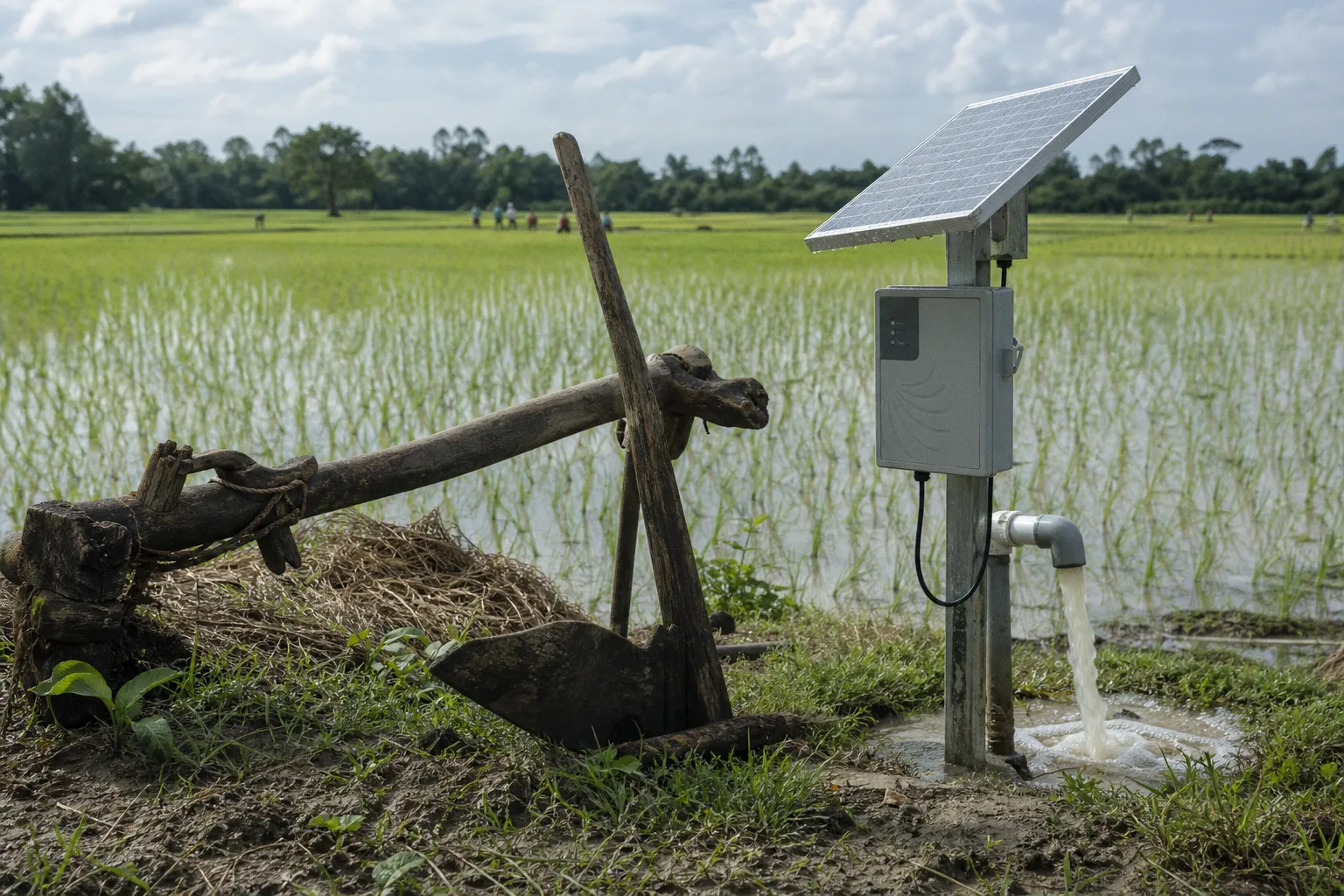
Its more consequential transformation is quieter: a farmer receiving a price signal by phone, a producer group recording transactions digitally, a retailer sourcing vegetables through a platform rather than a chain of informal calls, or a payment reaching a verified agricultural household through a card-linked system.
That distinction matters when reading the Bangladesh agritech startup landscape evolution. The sector is often described through the language of “smart farming”, but the investment and policy record points elsewhere. The largest activity has gathered around market access and finance — the two points where a smallholder most visibly meets the wider economy. Technology is becoming a connective layer between farms, traders, retailers, banks and public services, rather than a replacement for farming knowledge built over generations.
Bangladesh’s agricultural economy has always rested on dense human networks: local input sellers, village collectors, transporters, wholesale markets, extension officers and family labour. Digital platforms are entering that landscape not as blank-slate disruptors, but as new infrastructure within an old and intricate system.
From ICT policy to a more practical digital agriculture
The policy roots of Bangladesh’s digital agriculture effort stretch back well before the present startup cycle. The National ICT Policy of 2009 identified agriculture as an area where technology could support productivity, market linkage, farmer databases and climate-related services. By 2015, both the updated National ICT Policy and the National Agricultural Extension Policy had reinforced the place of e-agriculture and ICT-enabled advisory services.
This earlier phase was largely about access to information. Farmers could seek crop advice, receive weather-related updates, learn about disease management or contact helplines. These services remain meaningful in a country where the distance between a government office, a research institute and a remote farming community can still be measured in difficult travel rather than kilometres alone.
As of a July 2026 update, the Bangladesh National Portal listed five agriculture-focused mobile services: e-Krishok, Digital Krishi, the 3331 Krishak Bandhu phone service, BARI’s agricultural technology repository app and Krishoker Janala. Taken together, they show a state-led digital layer that has grown around information and extension.
But information alone does not resolve the farmer’s central commercial dilemma. Knowing the recommended fertiliser dose is useful; being able to finance the purchase, sell output at a predictable rate and receive the proceeds safely is another matter entirely.
The newer generation of agritech businesses is therefore trying to bind together functions that once sat apart:
- crop and market information;
- access to seeds, fertiliser, feed or equipment;
- logistics between farm areas and urban retail markets;
- digital payment collection and settlement;
- working-capital or embedded-finance models;
- data records that can gradually make a farmer more visible to formal financial institutions.
This is a shift from “an app for agriculture” to a platform that attempts to organise transactions around agriculture. The difference may sound technical, but it is social as much as digital. A platform enters existing relationships of trust, credit, bargaining and transport — relationships that cannot simply be coded away.
Bangladesh’s agritech story is less about making farms futuristic than making agricultural transactions less opaque.
The $20 million question: where investment has actually gone
Agritech investment trends in Dhaka are still modest beside the capital flowing into larger fintech, commerce or logistics ventures. A B-Briddhi and LightCastle landscape assessment estimated cumulative funding raised by Bangladeshi agritech enterprises at around $20 million. That is an instructive figure, but it should not be mistaken for a live 2026 market valuation or an annual investment total. It is a landscape estimate: a useful contour, not a definitive census.
Its composition is more revealing than its size. Half of the estimated investment went to market-access businesses, while farmer-finance businesses accounted for 41%. Input-access ventures represented 4.8%, and technology-access businesses 4.2%.
| Segment | Share of estimated agritech investment | What the pattern suggests |
|---|---|---|
| Market access | 50% | Investors see value in linking farm output with buyers, retailers and logistics networks |
| Farmer finance | 41% | Limited formal credit remains one of the sector’s deepest structural constraints |
| Input access | 4.8% | Digital procurement matters, but it has attracted less capital than trade and finance |
| Technology access | 4.2% | Advanced farm technology remains a small part of the investable agritech picture |
The distribution challenges a familiar assumption: that agritech is mainly an AI, drone or Internet of Things category. In Bangladesh, it is more often an exercise in supply-chain repair. The most investable question has been how to reduce uncertainty between the farm gate and the buyer, or between a farmer’s seasonal cash needs and the formal financial system’s reluctance to lend.
Fashol offers one visible example. Founded in 2020, the company announced a Tk 10 crore, or $1 million, pre-seed round in April 2023. Its stated plan was to optimise farmer-to-retailer supply chains, use data to narrow supply-demand gaps and automate transactions. The phrasing is familiar to startup audiences, but its practical target is recognisably local: perishable produce moving through fragmented routes into dense urban markets.
The growth narratives around platforms such as iFarmer and WeGro have similarly helped establish a broader public vocabulary for digital credit, marketplace linkage and farm-facing services. Yet the sector should resist converting visibility into proof of nationwide impact. There is no authoritative current registry of active agritech startups, no reliable national figure for the share of farmers using digital platforms, and no independently verified evidence that platforms have consistently raised incomes or reduced post-harvest losses across Bangladesh.
That restraint is not pessimism. It is a clearer way of seeing a young ecosystem.
Market access is really a logistics problem
The phrase “cutting out the middleman” has become one of the least useful lines in discussions of agricultural technology. Middlemen do not exist merely because information is scarce. They often aggregate small quantities, advance cash, arrange transport, absorb some risk and understand the rhythms of local markets. They can also extract value from farmers’ limited bargaining power. Both realities can be true at once.
For a digital marketplace, the challenge is not simply to remove an intermediary. It is to decide which functions must be replaced, formalised or shared.
A platform serving a vegetable-growing area must contend with collection timing, grading, storage, route density, retailer demand, payment delays and the fragility of perishable goods. If a buyer cancels after produce has been collected, a polished interface does not solve the loss. If the platform cannot assemble sufficient volumes for a vehicle route, delivery economics become unforgiving. If farmers are paid later than expected, trust can disappear faster than a customer-acquisition strategy can repair it.
Supply chain automation in agriculture therefore has a decidedly physical character. The digital layer may forecast demand or reconcile orders, but the actual system is made of sacks, crates, trucks, cold-storage gaps, market schedules and people who know which roads become difficult in the monsoon.
This is why market-access models have attracted the largest share of estimated agritech investment. They sit at the point where digital coordination can potentially create measurable efficiencies: aggregating orders, matching supply with retail demand, reducing manual reconciliation and bringing greater visibility to price and volume flows.
The aspiration is reasonable. The conclusion must remain cautious. Digital platforms have not demonstrably eliminated intermediaries across Bangladesh, nor has a national evidence base established that they consistently secure better farm-gate prices. What they can do, in specific corridors and crop categories, is make a portion of the chain more legible.
Finance: the deeper infrastructure beneath the app
If market linkage is the visible face of agritech, finance is often the condition beneath it. Smallholders need capital before harvest, while formal lenders frequently struggle with irregular incomes, sparse documentation and the perceived risk of agriculture. Informal credit fills that gap, but often at terms that leave farmers with limited flexibility over where and when they sell.
Digital credit for farmers in Bangladesh is therefore not just a lending product. It is a question of records, repayment rhythms, identity, crop cycles and payment rails.
Mobile financial services have supplied part of the enabling architecture. Bangladesh Bank introduced mobile financial services in 2011, and the regulatory framework permits transactions including cash-in, cash-out, person-to-person, person-to-business, business-to-person, person-to-government and government-to-person transfers. bKash is among the providers listed by the central bank, though there is no evidence that it is integrated with every major agritech platform or that agritech-specific transaction volumes can be reliably quantified.
The significance of mobile money lies less in a single brand than in the normalisation of digital settlement. Once a transaction can be recorded and paid electronically, it becomes easier — at least in principle — to build a service history around it. That history may help a producer group, lender or platform assess activity more clearly than a purely cash-based relationship allows.
There is a wider international reminder here: debates over digital money are increasingly shaped by questions of regulation, reserves and public infrastructure, as seen in the changing digital-dollar landscape for stablecoin issuers. Bangladesh’s agricultural payments conversation is far more immediate and local: can a farmer receive money reliably, can public support reach the intended person, and can a transaction trail support access rather than create another layer of exclusion?
FAO’s 2023 introduction of its MicroBanking System, known as MBWin, illustrates a collective approach. The system was introduced for farmer organisations, with five trained specialist operators intended to support 11,000 farmers belonging to 55 producer organisations. This is not a claim of mass national digitisation. It is, however, a practical recognition that farmer groups can act as an institutional bridge where individual digital adoption is uneven.
A farmer’s digital footprint is useful only if it produces fairer access to money, not simply more data for somebody else.
Digital Villages and the Farmer Card: building the public layer
Startups tend to receive the most attention, but Bangladesh’s agritech future will also be shaped by public systems whose scale may ultimately exceed that of any individual platform.
FAO reported that 60 Digital Villages were operating across Barishal, Rangpur and Cox’s Bazar in 2022. These sites offered government and private e-services, digital-literacy training and spaces for information exchange. Their value lies in their modesty. A village-based service point can make digital agriculture less dependent on every farmer owning a high-end device, navigating an unfamiliar interface or trusting a distant platform immediately.
The current Farmer Card pilot points toward a more integrated form of state infrastructure. In May 2026, the programme was operating in Tangail, with the first phase targeting around 22,000 farmers across 11 agricultural blocks, 11 upazilas and 10 districts. The reported model includes POS-based financial services and a phased plan for wider expansion.
The promise is substantial: a verified farmer identity linked to financial services could help target support, document transactions and create a clearer route for public payments. Yet the programme is still a pilot, not a nationwide rollout. Its eventual significance will depend on details that are easy to overlook in launch announcements:
1. Whether farmer registration reflects real cultivation arrangements. Land ownership, tenancy, family labour and seasonal leasing can be more complicated than a single database field suggests.
2. Whether local service points are accessible. A card is only useful if it can be used without costly travel, prolonged queues or dependence on a local agent whose capacity is already stretched.
3. Whether records are accurate and correctable. A digital identity system needs a credible way to fix errors. For agricultural households, an inaccurate record can affect more than convenience; it can affect eligibility and cash flow.
4. Whether women farmers are visible within the system. Women’s work in farming, livestock and post-harvest activity is extensive, but formal recognition can be uneven. Digital infrastructure can reproduce that invisibility unless registration and service design actively address it.
5. Whether public and private systems can coexist without locking farmers into one channel. The strongest ecosystem would allow farmers to use public services, mobile money, cooperatives and private platforms without surrendering choice.
This is where the intergenerational shift becomes visible. Younger farmers, rural entrepreneurs and family members living in towns may be more comfortable handling apps, digital payments or online ordering. But agricultural innovation cannot be designed only for the most connected user. It must also work for older farmers, shared-phone households and communities where trust remains rooted in people rather than interfaces.
The limits of the platform narrative
Bangladesh’s agritech sector is early-stage and uneven by almost every available measure. That is not a weakness of ambition; it is a description of the operating environment.
Fragmented supply chains remain a core challenge. Formal finance is still difficult for many smallholders to access. Bureaucratic barriers can slow partnerships and data-sharing. Connectivity has expanded, but access to a phone is not the same as confidence in a digital service, and confidence in a service is not the same as repeated use.
There is also a tendency to imagine that technology arrives in a rural economy as a clean break. Bangladesh’s experience suggests something more layered. Traditional channels persist because they solve real problems, even when imperfectly. A local trader may provide immediate liquidity. An input dealer may extend credit because they know the household. A producer group may offer social assurance that a platform cannot replicate through a user agreement.
The most durable agritech ventures will likely be those that understand this social architecture. They will need to build partnerships with cooperatives, retailers, financial institutions, extension networks and local logistics operators. They will need patient systems for dispute resolution and farmer onboarding. And they will need to be honest about unit economics in a low-margin, high-variability market.
The future of smart farming in Bangladesh may indeed include more remote sensing, mechanisation, climate analytics and precision tools. But those technologies will not define the sector’s success on their own. The immediate work is more foundational: reliable records, better transaction flows, transparent market linkage and finance that fits agricultural seasons rather than forcing agriculture into urban lending assumptions.
A digital layer, not a digital replacement
Bangladesh agritech startup landscape evolution is best understood as an effort to make the agricultural economy more connected without pretending it can be remade overnight. The sector has moved beyond basic advisory apps, but it has not crossed into universally digital farming. Its most meaningful experiments sit in the middle: linking farmers to markets, building payment trails, organising finance and testing public identity infrastructure.
The $20 million cumulative funding estimate is small, yet it has already clarified where the pressure points are. Capital has followed market access and finance because those are where the system is most constrained — and where a well-designed digital layer may create tangible value.
The task now is not to celebrate every platform as a revolution. It is to watch which ones earn durable trust across the farm, the collection point, the retailer’s shelf and the payment screen. In Bangladesh, the most credible agritech innovation will not erase the country’s agricultural relationships. It will make them more visible, more reliable and, ideally, more equitable.