Binimoy Platform: Key Features of Fintech Interoperability
The numbers tell the story before the narrative does. In July 2025, Bangladesh's interoperable digital transaction platform recorded 40,744 transactions worth Tk 14.72 crore.
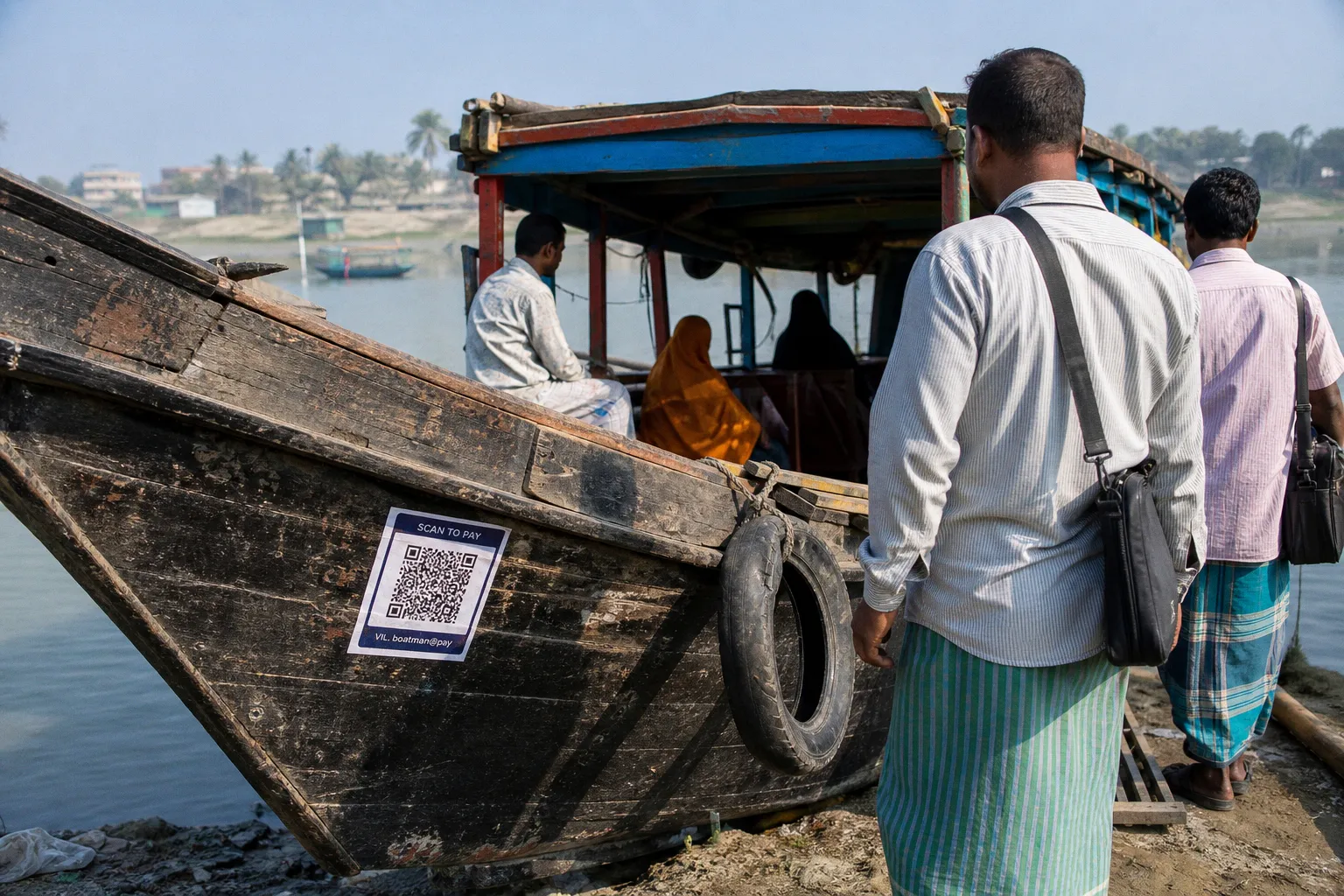
Binimoy Platform: Key Features of Fintech Interoperability
By October, that figure had slipped to 36,444 transactions worth Tk 14.04 crore — a roughly 10.5% drop in volume and a 4.6% contraction in value across a single quarter. The trajectory looks like a system cooling off rather than a platform gaining traction. In August, between those two endpoints, the central bank reportedly pulled the plug. The Daily Star reported on August 4, 2025, that Bangladesh Bank had suspended and scrapped Binimoy, citing irregularities and contract breaches. Yet the same central bank's transaction-trend page continues to list IDTP activity through October 2025. That gap between the official record and the press reporting is the central tension this piece has to navigate: what was Binimoy, how was it built, and what is actually left of it?
The Architectural Blueprint: Virtual IDs as the Routing Layer
At its core, Binimoy was designed as a routing layer — not a wallet, not a bank account, but an addressing system that sat above the existing infrastructure of banks, mobile financial service providers (MFS) and payment service providers (PSP). The standard identifier was the Virtual ID, or VID. In Bangladesh Bank's operating rules, the VID was intended to function like an email-style address: a single handle that could resolve to multiple underlying accounts without exposing the recipient's National ID, phone number or bank details to the sender.
The architecture imposed one strict constraint: one user, one VID. That single VID could be linked to multiple accounts across multiple institutions — a bKash wallet, a Nagad account, a bank current account, a card account — but the user's identity to the outside world was always the VID. The operating rules gave separate examples for individual, business, financial-institution and government VIDs, which suggests the platform was conceived as a public-infrastructure utility rather than a private rails product. The identifier was deliberately decoupled from any single institution's customer records.
Two design choices made the VID more than a privacy tool. First, users could designate a default receiving account; if the sender only knew the VID, the funds landed in that default. Second, users could assign aliases to individual linked accounts, allowing a sender to choose — "salary," "rent," "savings" — which underlying account the payment should hit. This is the difference between a payment address and a payment instruction. Most interoperability schemes stop at the former; Binimoy's rulebook reached for the latter. The government disbursement flow was the only one that did not use VIDs, which kept state-to-citizen transfers on a separate rail rather than mixing them into the consumer addressing system.
The VID was not a wallet. It was an address book that could route a single payment instruction to whichever underlying account the user wanted exposed.
Operational Mechanics: Clearing, Settlement and the Two-Layer Rail
The mechanics deserve a careful breakdown, because the conflation of "real-time clearing" and "instant settlement" is responsible for a lot of public confusion about what the platform actually did.
Bangladesh Bank's operating rules are precise on this point. Binimoy performed real-time clearing — the validation, fraud screening and instruction matching — at the moment of the transaction. Inter-institution settlement, the actual movement of funds between the sending and receiving institutions, was deferred and completed periodically through Bangladesh Bank's settlement process. In other words, the platform offered instant routing but not instant finality. Any claim that Binimoy settled transactions in real time across the entire chain is not what the rulebook says. The two functions were deliberately separated, which is standard central-bank payments architecture but routinely misunderstood in consumer-facing coverage.
The transaction flows the rulebook specifies are four. First, Direct Pay — a sender's institution debits the sender's account, and the receiving institution credits the recipient's default account unless the sender specifies an alias. Second, Request to Pay (RTP) — a creditor, typically a merchant, sends an instruction, the debtor accepts it through their own institution, and a Direct Pay is then initiated. Third, government disbursement, which sits on a separate flow. Fourth, salary and e-commerce payments, built on the RTP and Direct Pay primitives.
The e-commerce flow is the most architecturally revealing. The merchant does not hold the customer's credentials. The merchant's institution sends an RTP, the customer's institution prompts the customer, and only then does a Direct Pay fire. That is a deliberate firewall between the merchant and the payment instrument — a design choice that distinguishes Binimoy from card-on-file models where the merchant stores tokenised card data. In a market where MFS apps already dominate person-to-person payments, the e-commerce flow was the one with the most commercial upside.
Fees were not uniform. The rulebook distinguishes interoperable fees, which depend on the sending and receiving institution types, the service type and the transaction amount, from platform fees, which depend on whether the flow is Direct Pay or RTP and the transaction amount, as set by Bangladesh Bank circulars. There is no universal consumer fee in the rules. Anyone who quotes a single "Binimoy fee" is simplifying beyond what the document supports, and any marketing-style claim of zero-cost transfers should be treated with caution.
Technical Integration: APIs, SDKs and the Retention Stack
The integration layer was where Binimoy either lived or died, and the rules are unusually detailed about it.
The Binimoy Client Platform was designed to let participating institutions connect via APIs covering user management, transaction processing and reconciliation. On top of that, the rules specify an Android SDK for secure PIN capture — meaning the PIN never transits the merchant's app or the merchant's server — and a web PIN-capture platform built to cover iOS and internet-banking users who do not have access to the Android SDK. This is a meaningful security commitment: it puts the credential capture inside the bank or MFS app, not inside a third-party checkout page. In a market where phishing and SIM-swap fraud have been persistent problems, that choice was not cosmetic.
The retention rules are equally explicit. Digital transaction records were required to remain accessible through the platform or the participating institution's interface for up to 12 months. After that, archive backups had to be retained for up to 36 months from the transaction date, and cold-archive data for up to 10 years. Participating institutions were required to retain their own entry records for 10 years. That is a ten-year audit trail baked into the operating rules — a long shadow for any system that was supposed to run at consumer-grade speed, and a serious compliance burden for the participating institutions.
The platform's intended availability was 24 hours a day, 365 days a year, subject to maintenance or emergency downtime. Combined with the deferred net settlement architecture, this points to a system designed for high availability of the routing layer, with the central bank absorbing the timing risk of inter-institution settlement at the end of each cycle. That is the right shape for a national rail, but it requires the central bank to act as the settlement counterparty of last resort, which is a non-trivial operational commitment.
The Regulatory Pivot: Suspension, Scrapping and the IIPS Roadmap
This is where the architectural story collides with the operational reality.
According to The Daily Star, on August 4, 2025, Bangladesh Bank suspended and scrapped Binimoy, citing irregularities and contract breaches. The specifics of those irregularities were not laid out in the reviewed reporting. What is established is that the operating rules had only been issued in July 2024 — barely a year before the reported suspension — via PSD Circular No. 08/2024. The rulebook was younger than the platform's operational track record by a wide margin.
The official Bangladesh Bank transaction-trend page, however, continues to list IDTP activity through October 2025. The reviewed sources do not resolve this contradiction. There is no public notice in the material reviewed that explicitly confirms Binimoy has resumed operations after the August 2025 suspension. Any description of Binimoy as currently available for consumer payments should be read against that ambiguity. The numbers on the trend page may reflect residual settlement or reconciliation activity rather than live consumer usage.
What comes next is a different system. On November 24, 2025, The Daily Star reported that Bangladesh Bank plans a separate platform called the Inclusive Instant Payment System (IIPS), built on Mojaloop — the open-source interoperability software stewarded by the Mojaloop Foundation. The reported target: bring financial institutions under an interoperable system by July 2027.
The suspension ended a platform. Whether it ended the policy push for an interoperability rail is a different question, and the IIPS roadmap suggests the central bank is rebuilding rather than abandoning the goal.
The architectural implications are non-trivial. Mojaloop is a different stack from what the Binimoy rulebook describes. A transition to Mojaloop would mean re-integrating institutions, re-issuing addressing logic, and re-running the security and certification work that the Binimoy Client Platform had codified. It is not a software swap; it is a procurement and standards reset. The July 2027 target should be read as a policy goal, not as evidence that the replacement platform is already live.
Transaction Trends: What the Telemetry Shows
The IDTP transaction trend page is the only public telemetry the central bank has consistently published, and it tells a quiet story of stagnation rather than collapse.
| Month (2025) | Transactions | Value (Tk crore) |
|---|---|---|
| July | 40,744 | 14.72 |
| August | 40,380 | 14.74 |
| September | 37,190 | 14.37 |
| October | 36,444 | 14.04 |
From July to October, the platform shed roughly 4,300 monthly transactions and Tk 0.68 crore in value. The August print — the month of the reported suspension — was essentially flat with July, which suggests either the suspension was not enforced at the transaction layer immediately, or the trend page was reporting residual settlement activity. The September and October drops are sharper, and align more plausibly with the post-suspension narrative.
Two things are not in the data. First, there is no participant breakdown — no count of how many banks, MFS providers or PSPs were actually connected, or how heavily each was transacting. Second, there is no consumer-side metric: no count of unique users, no active merchant count, no average ticket size. Without those, the platform's reach cannot be assessed. The transaction count, in isolation, is a low-resolution picture.
What it does show is that even before the reported suspension, Binimoy was not on a growth curve. The platform was processing under 41,000 transactions a month at its apparent peak. For context, bKash alone processes hundreds of millions of transactions a month. Binimoy was, by volume, a rounding error in the national payments landscape.
The Verdict
Binimoy was an architecturally serious attempt to give Bangladesh a true interoperability rail — one VID per user, real-time clearing with deferred settlement, a credential-capture architecture that put the bank or MFS in control of the PIN, and a retention stack that ran to ten years. On paper, the rulebook reads like a careful piece of payments infrastructure.
In practice, the telemetry tells a different story. Volumes were modest, the trajectory was already cooling in the months before the reported August 2025 suspension, and the central bank has reportedly chosen to rebuild on Mojaloop rather than restart the existing platform. The IIPS target of July 2027 is a policy goal, not a live system — and the gap between a rulebook and a working rail is exactly what the last two years have cost Bangladesh.
The lessons are not technological. They are about procurement, governance and the speed at which an interoperable arrangement can be unwound when the central bank concludes that the operator has not delivered. The next rail will be judged on whether those lessons have been learned.