China International Supply Chain Expo: Global Trade Impact
The fourth China International Supply Chain Expo (CISCE) closed in Beijing on June 26 with 676 exhibitors from 85 countries and regions, an aggregation that underscores Beijing's accelerating effort…
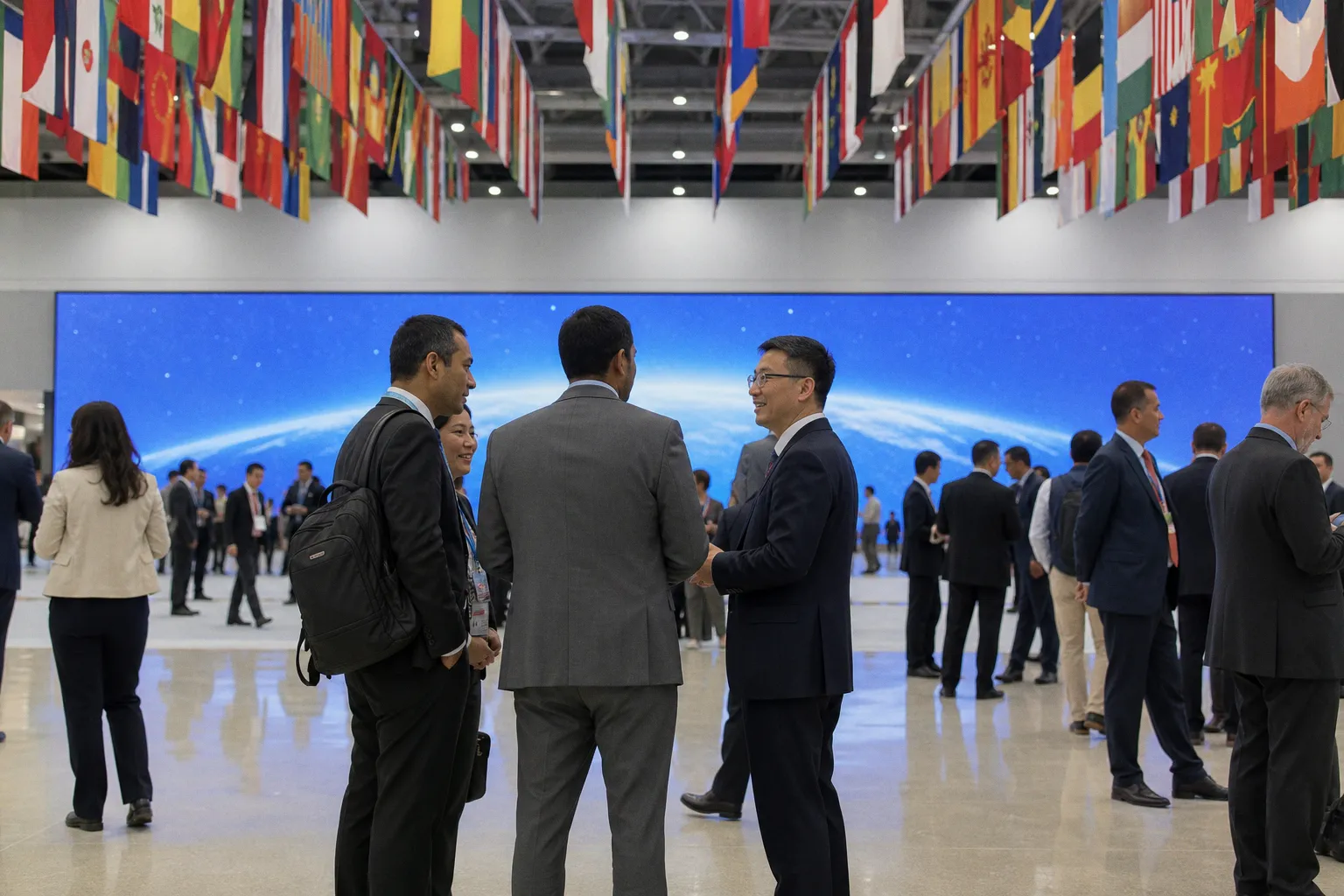
The fourth China International Supply Chain Expo (CISCE) closed in Beijing on June 26 with 676 exhibitors from 85 countries and regions, an aggregation that underscores Beijing's accelerating effort to institutionalize its position at the structural core of global trade flows. Overseas participants accounted for 36.5% of exhibitors, while Fortune 500 firms and industry leaders comprised 65%, according to organizers. The event ran under the theme "Connecting the World for a Shared Future."
Scale and the Shift to Platform-Based Coordination
The edition registered more than 1,200 exhibitors and supply chain partners on-site, with professional attendance up 22% year-on-year. Organizers logged 223 overseas business delegations, a 29.7% increase from the prior edition, and on-site matchmaking connected exhibitors with roughly 43,000 upstream and downstream firms. These figures exceed the throughput of comparable multilateral trade forums and signal a deliberate migration from episodic bilateral engagement toward platform-mediated coordination.
Australia served as guest country of honor, while France's Auvergne-Rhône-Alpes and Italy's Liguria joined as the first overseas guest regions, paired with Chinese provinces Anhui and Hainan. The arrangement formalizes subnational-level trade diplomacy within a national framework, creating channels that bypass traditional ministerial gatekeeping. Seventy business forums and two evening networking sessions ran alongside the exhibition floor, with livestreams accumulating over 62 million online views and more than 2,300 accredited Chinese and international journalists, a 21.5% increase from 2025.
Technology Layer and Resilience Architecture
The 2026 edition introduced the "Digital and Intelligent CISCE" initiative, upgrading the prior Digital Technology Chain into a Digital and Intelligent Technology Chain with a dedicated artificial intelligence zone. Organizers reported 161 global or industry debuts of products, technologies, and services. Concurrent releases included the Global Supply Chain Promotion Report and a new Global Supply Chain Resilience Index Matrix—both calibrated to operationalize supply chain stability as a measurable policy variable rather than a rhetorical aspiration.
On the final morning, 115 domestic and foreign firms signed letters of intent for the fifth CISCE, a 12.7% year-on-year increase. Twenty of those firms executed three- or five-year participation commitments, converting the expo from an annual event into a recurring institutional obligation and locking in multi-cycle attendance.
Reading the Signal for Bangladesh
For Bangladesh's export-oriented manufacturers—particularly in ready-made garments, where Chinese intermediate inputs and capital equipment underpin a substantial share of production value—CISCE's consolidation carries direct structural weight. A 65% concentration of Fortune 500 and industry leaders within a single Beijing-hosted venue concentrates procurement leverage in one location, a configuration that can compress margins for South Asian suppliers lacking direct exhibition access or government-backed pavilion arrangements.
The parallel trajectory matters here. Japan's reported effort to deepen emerging-economy supply chain ties, signaled in separate coverage, points to a bifurcating architecture in which Bangladesh must calibrate engagement across competing nodes rather than default to a single bilateral anchor. CISCE's subnational guest-region mechanism and its new resilience index together furnish a measurable framework against which Bangladesh's logistics and sourcing diversification strategies can be benchmarked across the next procurement cycle.