Bangladeshi food culture: Why rice and fish define the nation
Bangladesh produced 40.697 million metric tons of rice in 2023–24 and 5.018 million metric tons of fish in FY 2023–24. Those two figures explain more about Bangladeshi food culture than the familiar slogan ever can.
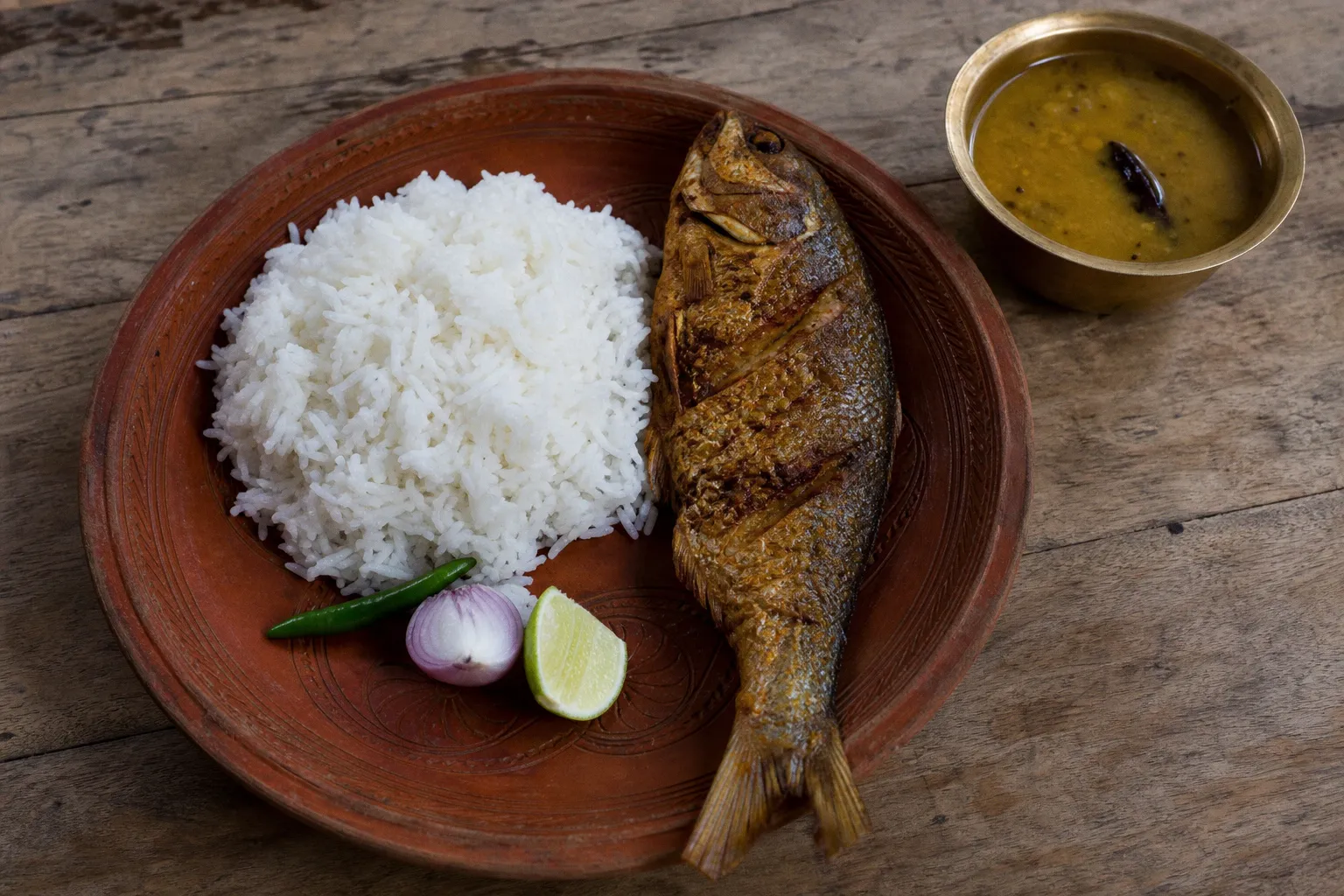
Rice and fish are not merely dominant ingredients; they are the output of a delta economy in which flooded plains, river systems, seasonal rainfall, cultivation cycles and inland fisheries have long structured household meals.
The phrase Machhe Bhate Bangali—commonly rendered as “Fish and Rice makes a Bengali”—therefore functions less as a culinary advertisement than as a condensed account of material history. It identifies a food system built around a dependable starch and an accessible, though unevenly distributed, source of animal protein. It does not establish a uniform national menu, and it should not be used that way. Bangladesh contains regional, religious, ethnic, class and urban-rural differences that cannot be reduced to one plate. But rice and fish remain the central reference point against which those differences are understood.
The deltaic roots of a culinary identity
Traditional Bengali cuisine in Bangladesh developed within an environment where rice farming and fishing were not specialised activities at the margins of the economy. They were fundamental occupations. The country’s deltaic terrain, extensive rivers and year-round rainfall created conditions in which paddy could be cultivated across multiple seasons and fish could be caught or raised through inland water systems.
This geography produced a practical dietary alignment. Rice supplied volume, calories and storage capacity. Fish supplied protein and could be prepared in forms suited to daily cooking: fried, curried, dried, mashed, steamed or paired with vegetables and pulses. The strength of the rice-and-fish combination lies partly in this flexibility. It operates as a complete everyday meal, but it also accepts adjustment according to season, income, local availability and household preference.
The cultural prominence of rice is therefore not simply symbolic. It reflects the institutional importance of paddy production to food supply and rural livelihoods. Fish holds a parallel, though more fragmented, position. Its supply moves through inland capture fisheries, aquaculture and marine fisheries, each with different production conditions, market routes and price pressures.
Rice and fish define Bangladeshi food culture because they emerged from the same geography, but their cultural status should not obscure the different systems that place them on the table.
The formula also explains why meals that appear simple to an outside observer can carry substantial regional distinction. The rice may vary by harvest and grain type; the fish may be freshwater, farmed, river-caught or marine; the preparation may lean toward mustard, chilli, turmeric, lentils, greens or fermented elements. A plate of rice and fish is not a single dish. It is a framework into which Bangladesh’s local food economies are fitted.
Quantifying the staple: rice production and diversity
National rice output illustrates the scale of that framework. In 2023–24, Bangladesh produced 406.97 lakh metric tons of rice, equivalent to 40.697 million metric tons. The total was distributed across three major seasonal categories: boro, aman and aus.
| Rice season | Production in 2023–24 | Position in the food system |
|---|---|---|
| Boro | 21.068 million metric tons | The largest component of annual rice output |
| Aman | 16.656 million metric tons | A major seasonal pillar of domestic supply |
| Aus | 2.973 million metric tons | Smaller in volume but part of the wider seasonal cycle |
| Total | 40.697 million metric tons | The production base behind rice’s central dietary role |
The figures do not mean that every household experiences rice in the same way. Production aggregates do not measure affordability, land ownership, market access or nutrition. They do, however, establish why rice remains the default point of reference in Bangladesh culinary traditions. Its presence is not limited to the lunch or dinner plate; it extends into breakfast, festival foods, ritual foods and preparations associated with scarcity.
Panta is among the clearest examples. It is made by soaking cooked rice overnight in water, allowing a slight fermentation, and is commonly eaten with salt and chilli. Its significance is structural rather than decorative: it shows how cooked rice can be carried into the next day, altered by time and water, and turned into a filling meal. That economy of use matters in a food culture shaped by seasonality and household resource management.
Rice also changes form without losing its social function:
- Khichuri combines rice and lentils into a meal whose value lies in its flexibility: it can be plain, vegetable-led or expanded with fish, meat and eggs depending on circumstances.
- Payesh uses rice with milk and sugar, transferring the staple from routine sustenance into a celebratory register.
- Pitha relies heavily on rice flour, making rice central to a broad family of snacks and festival preparations rather than only to the main meal.
- Panta demonstrates preservation through household practice, where leftover rice becomes a distinct preparation rather than waste.
The pitha festival significance is often discussed in cultural terms, and that is appropriate, but its economic base should be retained. Rice flour makes pitha possible because rice is available across the country’s agricultural system and can be transformed into durable, portable and highly variable forms. The same staple appears in everyday survival, domestic hospitality and ceremonial food. That breadth is more consequential than any one recipe.
The protein backbone: fisheries and the hilsa legacy
Fish occupies an equally central but more complex position. Bangladesh produced 50.18 lakh metric tons of fish in FY 2023–24, or 5.018 million metric tons. Aquaculture accounted for 29.78 lakh metric tons, inland capture fisheries for 14.11 lakh metric tons, and marine fisheries for 6.29 lakh metric tons.
| Fishery source | Production in FY 2023–24 | What it indicates |
|---|---|---|
| Aquaculture | 2.978 million metric tons | The largest source within national fish output |
| Inland capture fisheries | 1.411 million metric tons | The continuing role of rivers, floodplains and inland waters |
| Marine fisheries | 0.629 million metric tons | A smaller but distinct coastal contribution |
| Total fish production | 5.018 million metric tons | The scale of fish within the national food system |
The Department of Fisheries reported that fish supplied approximately 60% of animal protein consumed in the country during the same fiscal year. Annual per-capita fish intake was reported at 24.74 kg. These are substantial indicators, but they should be read precisely. National production and per-capita calculations do not establish how frequently individual households consume fish, what species they buy, or whether premium fish remains within reach during periods of price pressure.
That distinction is particularly relevant to hilsa, or ilish. Hilsa is Bangladesh’s national fish and holds a status that goes beyond volume. It has become a marker of seasonal food culture, regional identity and hospitality. Yet it is not interchangeable with fish as a category. Official statistics put hilsa production at 529,000 metric tons in FY 2023–24, a decline of 7.83% from the preceding year. Even at that level, hilsa represented only one part of a fish system sustained by ponds, rivers, floodplains and the sea.
Its symbolic prominence should therefore be separated from a claim of universal access. Hilsa is a prized fish, and household purchasing power determines whether it appears as a routine purchase, an occasional meal or a market reference point. The national-fish designation describes cultural standing; it does not create a single consumption pattern across Bangladesh.
Hilsa provides the culinary emblem, but aquaculture, inland capture and marine supply provide the broader protein infrastructure.
This is where the maach-e-bhaat-e-bangali heritage becomes analytically useful. The expression does not mean that every Bengali eats identical fish with identical rice. It identifies an enduring relationship between a staple grain and a dispersed protein economy. The relationship is national in cultural recognition but local in its actual execution.
Beyond the plate: rice as cultural and festive symbol
Rice has an unusually broad role in Bangladeshi food culture because it moves easily between categories that other food systems tend to keep separate. It is daily nourishment, a basis for sweets, an ingredient in snacks, a component of religious and seasonal observance, and a resource used carefully in periods of constraint.
That breadth becomes visible around Pahela Baishakh, when panta and hilsa are frequently invoked as a cultural pairing. The pairing has clear public recognition, but it should not be treated as a compulsory meal for all Bangladeshis or as evidence of a single national ritual. Food practice is shaped by household income, locality, faith and individual preference. Public visibility is not the same thing as universal participation.
The same caution applies to claims about a national dish. Bangladesh has a national fish—hilsa—but the available record does not establish a single officially designated national dish. The distinction matters because culinary identity is often simplified for tourism, restaurant branding and social media circulation. Those formats favour one recognisable plate. Bangladesh’s food system has no need for such compression.
In Dhaka food history, this tension is especially visible. Urban restaurant culture has expanded the range of available food, from regional Bengali dishes to wheat breads, meat preparations, fast food and international formats. Yet the rise of these options has not displaced rice from its institutional and domestic position. Rice remains the organising staple in many households even as the city’s commercial food landscape becomes more diversified.
This produces two overlapping food economies. One is the household economy of rice, fish, lentils, vegetables and seasonal adjustment. The other is the urban consumption economy, where restaurant openings, delivery platforms and changing work patterns create demand for faster, more specialised or more globally recognisable meals. Neither should be mistaken for the whole of Bangladesh. Their coexistence is the relevant fact.
Diversity is not an exception to the rice-and-fish framework
The most persistent error in writing about Bangladesh culinary traditions is to describe diversity as a minor qualification after asserting a fixed national diet. The order should be reversed. Bangladesh contains Muslim, Hindu and tribal food practices, as well as major distinctions between rural and urban cooking. Wheat breads, meat dishes, vegetarian traditions, regional ingredients and commercial fast food all form part of the country’s food landscape.
Rice and fish remain central because they are historically and economically foundational, not because they erase these variations.
For many households, fish may mean small inland species, farmed varieties or dried fish rather than hilsa. For others, meat dishes may take greater prominence on particular days, occasions or within specific communities. In cities, restaurant menus can make rice appear less dominant than it is in domestic kitchens because commercial dining rewards novelty and format. A Dhaka menu is not a census of national eating habits.
The distinction between supply and access is equally material. Bangladesh’s 5.018 million metric tons of fish production demonstrate national capacity, but production data alone cannot determine who consumes which species and at what price. The same is true for rice. High output establishes the scale of the staple; it does not remove the importance of income, distribution, crop conditions or household budgeting.
A more accurate account of Bangladeshi food culture therefore rests on several propositions:
1. Rice is the country’s leading staple because agriculture, climate and household practice have made it structurally central.
2. Fish is a major protein source, supported by aquaculture, inland capture and marine production rather than by one iconic species alone.
3. Hilsa has national symbolic status, but it should not be used as a proxy for all fish consumption or assumed to be routinely affordable for every household.
4. Rice has cultural authority beyond the main meal through panta, khichuri, payesh and pitha.
5. Religious, ethnic, regional and urban differences are part of the food culture itself, not deviations from it.
A durable identity under changing conditions
Rice and fish will remain the central grammar of Bangladeshi food culture because the underlying production system remains large. Boro, aman and aus together delivered 40.697 million metric tons of rice in 2023–24. Aquaculture, inland capture fisheries and marine fisheries together delivered 5.018 million metric tons of fish in FY 2023–24. These are not symbolic numbers; they describe the scale of the two commodities around which everyday food security and culinary memory continue to operate.
The next phase of Bangladesh’s food culture will not be defined by whether rice and fish disappear from the national table. The more consequential question is how changing prices, urbanisation, aquaculture growth, fisheries conditions and consumer habits redistribute their role across households. Hilsa will retain bilateral cultural leverage in public imagination, while farmed and inland fish will continue to carry much of the volume. Rice will remain the staple, but its meaning will keep extending from the domestic pot to pitha, payesh, panta and the expanding urban food market.
The phrase Machhe Bhate Bangali endures because it captures this durable structure. Its value lies not in presenting Bangladesh as culinarily uniform, but in identifying the agricultural and aquatic foundation from which the country’s far more varied foodways have developed.